



2025 Mazda CX-30 vs. Toyota Corolla Cross
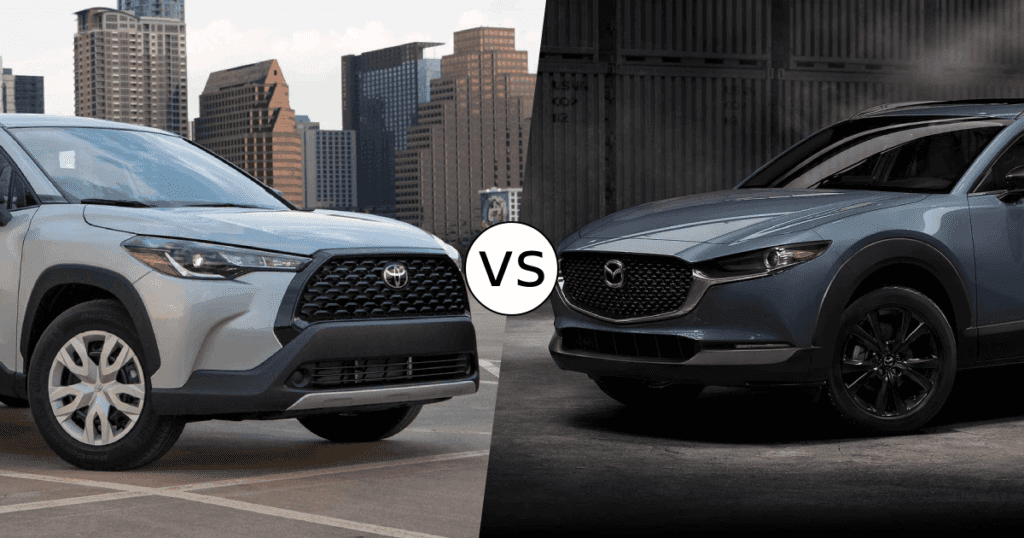
The 2025 Mazda CX-30 and Toyota Corolla Cross stand out in the compact SUV market, each offering unique strengths. They compete for the attention of Orange County drivers who are looking for a higher seat position and adequate cargo space without opting for a full-size truck. In this Toyota Corolla Cross vs. Mazda CX-30 specs comparison, our team at Capistrano Mazda explores everything from costs to driving experiences to help you determine which SUV fits your lifestyle.
Pricing and Value Analysis
The 2025 Mazda CX-30 starts at $25,195, while the Toyota Corolla Cross begins at $24,135 for the L trim with front-wheel drive (FWD). Mazda includes all-wheel drive (AWD) standard on all eight trims.
The Mazda CX-30 is available in eight trim levels: the S, S Select Sport, S Preferred, S Carbon Edition, S Premium, Carbon Turbo, Turbo Premium, and Turbo Premium Plus, with starting MSRPs ranging from $25,195 to $37,150. The Toyota Corolla Cross is available in the L, LE, and XLE models with starting prices of $24,135, $26,465, and $28,360, respectively.
Performance and Driving Experience
The 2025 Mazda CX-30 offers two engines, compared to Toyota’s single option. The standard CX-30’s 2.5-liter four-cylinder engine produces 191 horsepower and 186 lb-ft of torque, which is noticeably stronger than the Corolla Cross’s 2.0-liter four-cylinder that generates 169 horsepower and 151 lb-ft of torque.
Mazda’s optional turbocharged 2.5-liter delivers 250 horsepower and 320 lb-ft of torque. Both the CX-30 engines are paired with a six-speed automatic transmission, while the Corolla Cross features a continuously variable transmission designed for efficiency.
Toyota leads in terms of fuel economy, achieving 31 mpg in the city, 33 mpg on the highway, and 32 mpg combined. The CX-30 provides 26 mpg in the city, 33 mpg on the highway, and 29 mpg combined with the standard engine or 22 mpg in the city, 30 mpg on the highway, and 25 mpg combined with the turbocharged option.
Interior Space and Comfort
Toyota offers more front passenger space, with 38.6 inches of headroom and 42.9 inches of legroom, compared to the CX-30’s 38.1 inches of headroom and 41.7 inches of legroom. Rear seating favors Mazda with 36.3 inches of legroom compared to Toyota’s tight 32 inches. The Corolla Cross provides more rear headroom at 39 inches compared to the 38.3 inches in the CX-30.
The Corolla Cross edges ahead in terms of cargo capacity, offering a maximum of 24 cubic feet behind the rear seats versus the CX-30’s 20.2 cubic feet. With seats down, Toyota provides 66 cubic feet compared to Mazda’s 45.2 cubic feet.
Passenger volume is closely matched with 94.9 cubic feet in the Corolla Cross without a sunroof versus 94.1 cubic feet in the CX-30. Adding a sunroof decreases the Toyota’s capacity to 93.8 cubic feet, giving Mazda a slight edge. The CX-30 offers more premium materials and a cleaner layout, while both provide a comfortable driving experience.
Technology and Infotainment
The Corolla Cross comes standard with a 7-inch touch screen in the base L trim, which increases to 8 inches in the LE, and features a 10.5-inch screen in the XLE. All models include standard wireless Apple CarPlay and Android Auto, as well as Toyota Safety Sense 3.0. A standard six-speaker setup is included, with an optional nine-speaker JBL system available as an upgrade.
The Mazda CX-30 features an 8.8-inch center display across all trims, with an optional 10.25-inch upgrade available. This setup comes with a one-year trial of Mazda Connected Services, as well as a six-speaker audio system with Mazda Harmonic Acoustics. Higher trims add wireless phone charging, wireless Apple CarPlay and Android Auto, and a 12-speaker Bose sound system.
Both vehicles offer advanced driver-assistance technologies, with Toyota’s Safety Sense 3.0 performing well during testing. The Mazda has a more upscale feel with its tech approach, while Toyota’s features are simple and user-friendly.
Exterior Design and Practicality
The 2025 Toyota Corolla Cross focuses on practicality. Its 103.9-inch wheelbase provides stability on highways, while 8.1 inches of ground clearance allows it to tackle challenging terrain with ease. Its more rectangular form and higher roofline simplify loading cargo. The Mazda CX-30 prioritizes aesthetics with its sleek, almost coupe-like silhouette combined with SUV durability. Although both SUVs offer a range of colors and wheel options, the Mazda stands out with its more striking appearance and attention to detail.
Reliability and Warranty Coverage
Toyota maintains its status for reliability, with the Corolla Cross scoring 79/100 by U.S. News. The Mazda CX-30 comes with a three-year/36,000-mile limited warranty and five-year/60,000-mile powertrain warranty. The CX-30 excels in safety tests, earning both a five-star rating from the National Highway Traffic Safety Administration (NHTSA) and a Top Safety Pick+ award from the Insurance Institute for Highway Safety. The Corolla Cross only received four stars in NHTSA front crash tests, though its crash prevention systems scored well.
Visit Capistrano Mazda Today
Your choice of compact SUV will depend on your priorities. The Corolla Cross prioritizes practicality with increased cargo space and improved fuel efficiency, while the Mazda CX-30 offers additional engine options, including a turbocharged version. If you’re in San Juan Capistrano, California, contact us today to explore our extensive inventory and schedule a test drive to determine whether the 2025 CX-30 fits your lifestyle.
0 comment(s) so far on 2025 Mazda CX-30 vs. Toyota Corolla Cross