



2025 Mazda CX-30 vs. Volkswagen Taos
The compact SUV market continues to grow as more buyers seek vehicles that blend practicality with style. The 2025 Mazda CX-30 and the 2025 Volkswagen Taos are two standout options in this segment. Both vehicles offer distinctive features and capabilities.
The Mazda CX-30 and its German competitor, the Volkswagen Taos, have the same starting MSRP of $24,995. Both vehicles have all-wheel-drive capabilities and modern safety features, making them strong contenders in this competitive segment. Read as we review the car comparison specs of these two vehicles to help you choose the right model for your daily Orange County, California, drive.
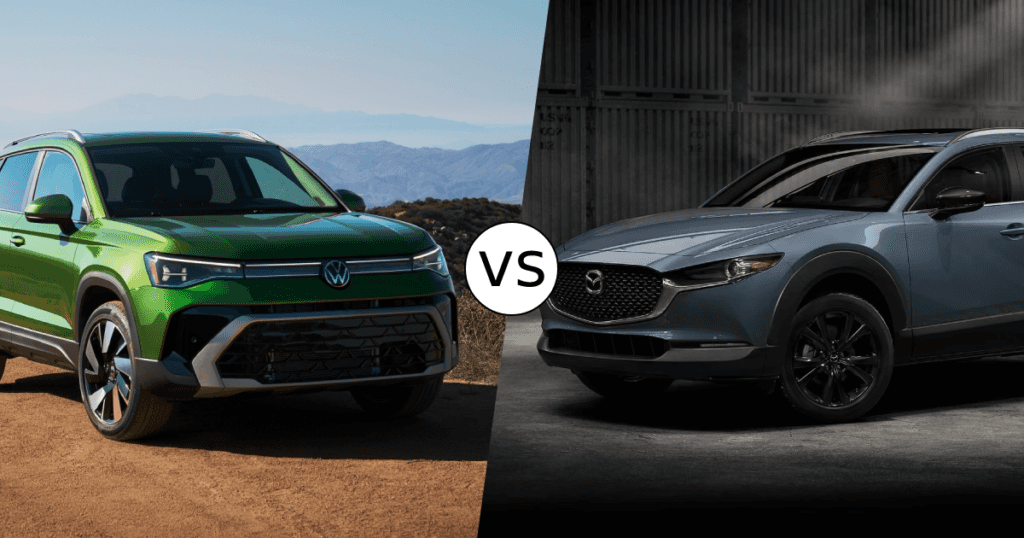
Detailed Comparison
The 2025 Mazda CX-30 and Volkswagen Taos offer compelling features that set them apart in the compact SUV segment. The Mazda CX-30 leads with superior horsepower and torque figures, while the Volkswagen Taos counters with more interior space and cargo capacity. Each vehicle includes advanced safety features and modern technology, making them attractive options for different types of buyers.
Pricing and Value
The 2025 Mazda CX-30 ranges from $24,995 to $36,950. The vehicle includes comprehensive warranty coverage and competitive standard features across all trim levels. The Volkswagen Taos offers a price range of $24,995 to $34,695. Both cars provide strong value propositions, though they target slightly different priorities in terms of standard features and available options.
Performance and Fuel Economy
The 2025 Mazda CX-30 showcases impressive performance credentials with its 2.5-liter four-cylinder engine, which delivers 191 hp and 186 lb-ft of torque. This powertrain configuration ensures responsive acceleration and confident passing power across various driving conditions. The CX-30 balances performance and economy, achieving 26 mpg in city driving and 33 mpg on highways.
For even better performance, the CX-30’s turbocharged engine can achieve up to 227 hp with premium 93 octane fuel. The engine’s low-end torque delivery provides impressive acceleration from a standstill, making it ideal for city driving and highway merging.
The CX-30’s sophisticated all-wheel-drive system enhances performance and safety in various weather conditions. This system continuously monitors road conditions and adjusts power distribution accordingly, providing optimal traction and stability. The responsive handling and well-tuned suspension deliver a driving experience that sets new standards in the compact SUV segment.
The Volkswagen Taos has a 1.5-liter turbocharged four-cylinder engine producing 174 hp and 184 lb-ft of torque. While the Taos has adequate power for daily driving, the CX-30 is more appealing if you want stronger performance and more engaging driving dynamics.
Interior and Comfort Features
The 2025 Mazda CX-30 and Volkswagen Taos offer distinctive approaches to interior comfort and functionality. The Mazda CX-30 takes a more premium approach to its interior design, offering 94.1 cubic feet of passenger volume, creating an open, airy feeling in the cabin. While its cargo space is a modest 20.2 cubic feet behind the rear seats, you can expand it to 45.2 cubic feet by folding the seats, providing adequate space for most daily needs and weekend adventures.
The Volkswagen Taos has impressive spaciousness with 37.9 inches of rear-seat legroom, providing passengers ample space to stretch out and remain comfortable during long journeys. Its cargo capacity is particularly noteworthy, offering 65.9 cubic feet of space with the rear seats folded, making it an excellent choice if you frequently need to transport larger items.
Both vehicles integrate modern technology, with sophisticated digital displays and seamless Android Auto and Apple CarPlay compatibility. The CX-30’s interior stands out with its upscale materials and attention to detail. Soft-touch surfaces are throughout the cabin, and precisely engineered controls provide satisfying tactile feedback. The ergonomic design of the driver’s area places all essential controls within easy reach, while the seating position offers excellent visibility and support.
Climate control systems in both vehicles ensure passenger comfort, with available dual-zone automatic climate control allowing different temperature settings for driver and passenger zones. Both vehicles prioritize seating comfort, with available heated front seats and power-adjustability for the driver’s position. The Taos’ wider dimensions translate to more shoulder and hip room, while the CX-30’s carefully contoured seats provide excellent support and positioning for a more engaged driving experience.
Safety and Driver-Assistance Features
The Mazda CX-30 has impressive safety features. The Insurance Institute for Highway Safety (IIHS) awarded it a Top Safety Pick+, giving it high ratings in small overlap front, moderate overlap front, and side crash tests. The CX-30 also features an effective pedestrian crash prevention system. The Volkswagen Taos includes standard blind-spot monitoring, rear cross-traffic alert, forward-collision warning, automated emergency braking, adaptive cruise control, and lane-centering technology.
Styling and Design
The Mazda CX-30 takes a more streamlined approach to design with flowing lines, while the Volkswagen Taos features modern exterior styling with sculpted lines that improve aerodynamics. The Taos includes adaptive front lighting, optional roof rails, and a rear power liftgate. It’s slightly larger at 175.8 inches long and 72.5 inches wide compared to the CX-30’s 173 and 70.7 inches, respectively.
Pros and Cons: Mazda CX-30 vs. Volkswagen Taos
The Mazda CX-30 and Volkswagen Taos both have pros and cons. Considering these can help you decide which model best suits your needs. Mazda CX-30 pros include the following:
- Higher horsepower (191 hp) and torque (186 lb-ft)
- Streamlined design
- Strong standard features package
- Top safety ratings from the IIHS
Mazda CX-30 cons include the following:
- Limited cargo space (20.2 cubic feet with the seats up)
The Volkswagen Taos offers the following pros:
- Spacious interior with 37.9 inches of rear legroom
- Large cargo capacity (65.9 cubic feet)
- Advanced technology features
The Volkswagen Taos cons include the following:
- Less powerful engine (174 hp, 184 lb-ft of torque)
- Lower ranking in the small SUV category
Buyers’ Guide: Making the Right Choice for You
Choosing between these vehicles depends largely on your priorities. The Mazda CX-30 stands out with its performance capabilities and safety ratings, making it ideal if you value responsive handling and acceleration.
The Volkswagen Taos offers excellent value for buyers needing maximum interior space and cargo capacity. Its impressive cargo space makes it practical for families or those with active lifestyles.
Consider your daily driving needs, budget constraints, and space requirements. Test-drive both vehicles to experience their different driving characteristics and interior comfort firsthand.
Choosing Your Ideal Compact SUV
The 2025 Mazda CX-30 and 2025 Volkswagen Taos each excel in different areas. The CX-30 leads in performance and safety ratings, while the Taos offers superior interior space. Both vehicles have a reasonable starting price, making them competitive options in the compact SUV segment. Are you ready to experience the 2025 Mazda CX-30 for yourself? Visit Capistrano Mazda today to schedule a test-drive and discover why the CX-30 may be the perfect compact SUV for your lifestyle.
0 comment(s) so far on 2025 Mazda CX-30 vs. Volkswagen Taos