



2025 Mazda CX-50 vs. Ford Bronco
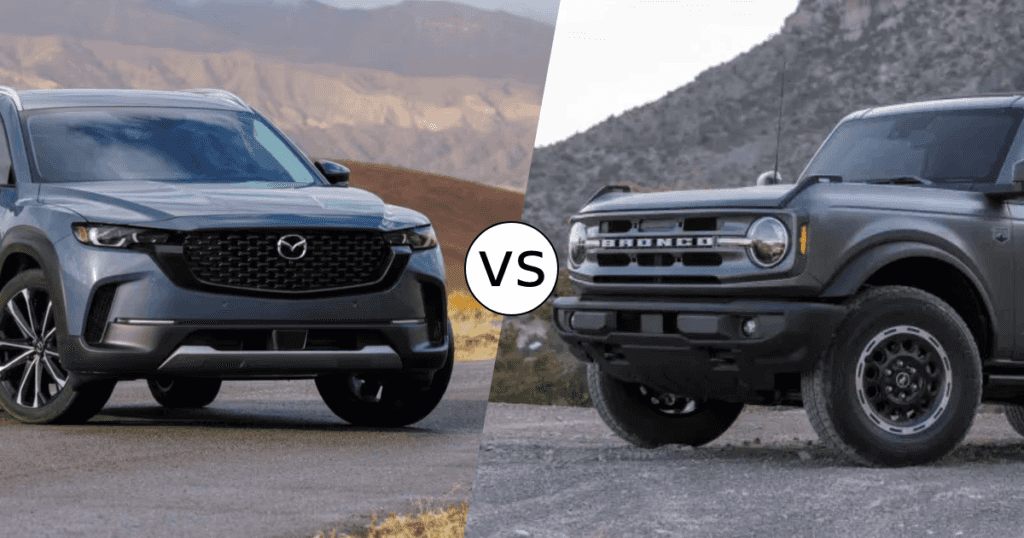
The compact SUV market continues to thrive with the introduction of the 2025 Mazda CX-50 and the Ford Bronco Sport. These two vehicles have their own blend of road-friendly comfort and off-road capability, though they start from opposite directions. The CX-50 favors sophistication and driving dynamics, while the Bronco Sport fully commits to an adventurous, rugged personality. In this car comparison review, we’ve broken down their key differences and similarities so you can figure out which one best meets your needs.
Pricing and Value
With seven gas trims ranging from the Select to the Turbo Premium Plus ($43,500), the CX-50 offers more choices than the Bronco Sport’s five trims (from the Big Bend through to the Badlands at $40,115). Midlevel CX-50s include standard features such as leather seats, while Ford adds them as costly extras. A CX-50 Preferred ($33,900) includes features that would cost thousands more on comparable Bronco models.
This is because Mazda bundles features logically across trims, while Ford leans toward extra packages, which can skew true cost comparisons. Make sure you’re clear about the features of each trim before committing to any purchase. New vehicle limited warranty coverage is identical at three years or 36,000 miles, so early ownership costs are broadly comparable.
Performance and Capabilities
Moving on to a car specification comparison of performance and capabilities, the CX-50 offers a 2.5-liter four-cylinder with 187 horsepower and 186 lb-ft of torque and a turbo 2.5-liter with 256 horsepower and 320 lb-ft of torque. The Bronco Sport offers a 1.5-liter EcoBoost three-cylinder with 180 horsepower and 200 lb-ft of torque and a 2.0-liter EcoBoost with 250 horsepower and 280 lb-ft of torque.
Mazda’s six-speed automatic shifts smoothly with distinct driving modes, including off-road. Ford’s eight-speed works effectively despite occasional hesitation, with specialized modes for sand or mud. Both include all-wheel drive but with different goals — the CX-50 prioritizes road grip with modest off-road ability, while the Bronco Sport’s four-wheel-drive system confidently tackles rough terrain.
The turbo CX-50 tows 3,500 pounds, while a properly equipped Bronco Sport Badlands can haul up to 2,700 pounds (the other trims remain at 2,200 pounds).
Design and Comfort
The CX-50 and Bronco Sport offer contrasting designs. The CX-50’s sleek profile measures 185.8 inches long, 72.9 inches wide with the mirrors folded, and 63.5 inches tall. The Bronco Sport’s boxy, upright stance is shorter in length at 172.7 inches but taller at 70.2 inches.
Inside, the CX-50 features luxury materials and thoughtful design with 31.4 cubic feet of cargo space or 56.3 cubic feet with the rear seats folded. The Bronco Sport offers more room, with 32.5 cubic feet behind the seats and 65.2 cubic feet in total. The CX-50 wins on comfort with a class-leading 39.8 inches of rear legroom. Tech options include the CX-50’s 10.25-inch screen with physical controls versus the Bronco’s larger 13.2-inch touch screen.
Each vehicle’s details reflect its purpose. The CX-50 has supportive seats for dynamic driving and strategically placed USB ports. The Bronco Sport features bottle openers, easy-clean surfaces, and flatter cushions for gear access. Sound insulation varies, too — the CX-50 has a very quiet cabin, while the Bronco lets in more outside sounds. Your choice depends on whether you value refinement or environmental connection.
Fuel Economy and Environmental Impact
Both SUVs offer solid fuel efficiency. The standard CX-50 gets 25 mpg in the city and 31 mpg on the highway, while its turbocharged version returns 23 mpg and 29 mpg, respectively. The Bronco Sport’s 1.5-liter gets 25 mpg in the city and 30 mpg on the highway, while the 2.0-liter manages 21 mpg and 27 mpg, respectively. The 2.0-liter engine also needs premium fuel, which may cost you more in the long run.
In real-world tests, the CX-50 often beats its EPA ratings, while the Bronco Sport typically meets or falls below its numbers. If you’re an eco-conscious California driver, the CX-50’s smaller carbon footprint may be more in line with your values.
Safety and Driver Assistance
Both SUVs include the manufacturer’s core driver-assist suites in every trim. Mazda includes blind-spot monitoring, adaptive cruise control, and lane departure warning as standard, while Ford provides forward collision warning and lane-keeping assist. The CX-50 earned a 2025 Top Safety Pick+ from the Insurance Institute for Highway Safety (IIHS), while the Bronco Sport failed to make the cut this year.
Higher trims pack advanced driver aids. The CX-50 includes traffic jam assist and a 360-degree parking camera, while the Bronco Sport features an off-road camera with washer function. Both offer automatic emergency braking for pedestrians, but the CX-50 also detects cyclists.
The CX-50 also offers two complete LATCH connector sets for the rear outboard seats, plus a middle seat tether anchor, earning the IIHS Good+ rating for ease of use. Ford includes a similar system, but you may find the Mazda’s easier to use.
Making the Right Choice: CX-50 or Bronco Sport?
If your daily routine includes smooth roads with a few light trails, the Mazda CX-50’s turbo engine, fuel savings, and upscale interior make it a compelling choice. If you love serious off-roading, the Bronco Sport’s ground clearance, trail-specific drive modes, and 2,700-pound tow rating may win you over. We think the Mazda is miles ahead of the Bronco Sport, but you can contact us at Capistrano Mazda in San Juan Capistrano, California, and conduct your own Mazda CX-50 review. We’ll talk you through its features, take you for a test-drive, and help you pick your ideal trim.
0 comment(s) so far on 2025 Mazda CX-50 vs. Ford Bronco