



2025 Mazda CX-50 vs. Subaru Forester
The 2025 Mazda CX-50 and Subaru Forester stand out as refreshing options in the compact SUV market, breaking away from common choices such as the Toyota RAV4 and Honda CR-V. With their distinct personalities and standard all-wheel-drive systems, these two adventure-ready vehicles deserve a closer look.
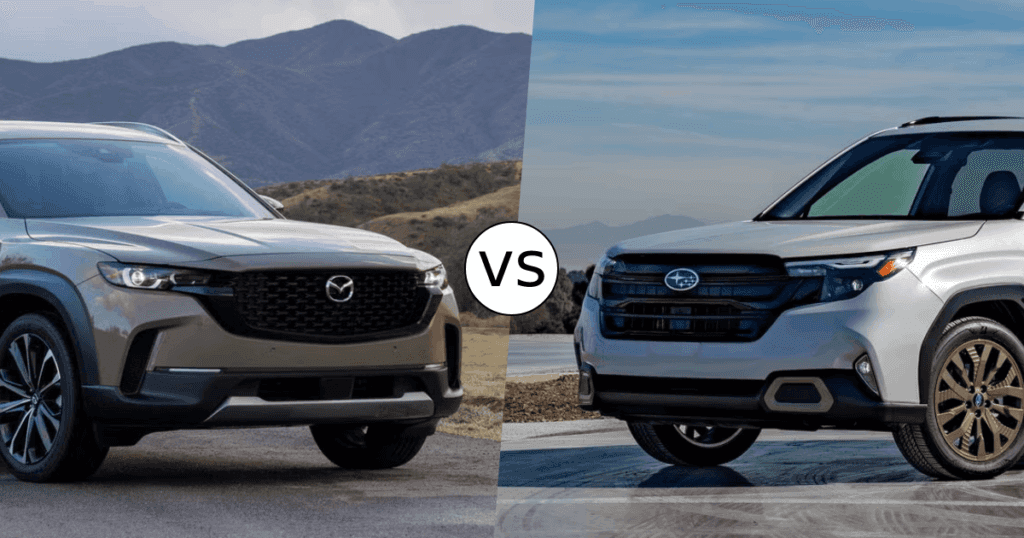
Overview of the 2025 Mazda CX-50 vs. Subaru Forester
These models cater to drivers who want capability with style, though their approaches differ. The CX-50 debuted in 2021, sitting between the CX-30 and CX-90 in Mazda’s lineup. The Forester dates back to 2000, but the 2025 model is completely redesigned. Both offer standard all-wheel drive with ground clearance suited for weekend adventures. Price-wise, they’re similar. The 2025 Mazda CX-50 has an MSRP of $30,350, while the 2025 Subaru Forester comes in slightly lower at $29,995.
Trim Levels and Top Features
The Subaru offers six trims: Base ($29,995), Premium ($33,385), Sport ($36,105), Wilderness ($36,285), Limited ($37,695), and Touring ($41,595). The Wilderness carries over from the 2024 version. The Limited features a 2.5-liter engine with a continuously variable transmission delivering 29 mpg combined, and over 8 inches of ground clearance.
Mazda provides seven trims across two engines: the 2.5 S Select ($30,350), 2.5 S Preferred ($31,850), 2.5 S Premium ($34,200), 2.5 S Premium Plus ($37,500), 2.5 Turbo Meridian Edition ($41,000), 2.5 Turbo Premium ($41,500), and 2.5 Turbo Premium Plus ($43,500). All trims feature a 2.5-liter four-cylinder engine, except the Turbo Meridian Edition, which upgrades to a 2.5-liter turbo engine delivering 29 mpg.
Performance and Driving Experience
Here’s where you’ll find they part ways. The Forester uses a 2.5-liter horizontally opposed four-cylinder engine generating 180 horsepower and 178 lb-ft of torque, paired with a continuously variable transmission tuned for smoothness. Mazda offers options: its base 2.5-liter produces 187 horsepower and 186 lb-ft through a six-speed automatic, while the turbocharged version delivers 256 horsepower and 320 lb-ft of torque.
Both brands offer hybrid variants. The Forester Hybrid combines its 2.5-liter engine with electric assistance for a combined 194 horsepower, achieving 35 mpg and a 581-mile range. The CX-50 Hybrid, built on Toyota technology, uses three electric motors and a 2.5-liter engine, providing a total of 219 horsepower, 38 mpg combined, and a 490-mile range.
Exterior Design and Aesthetics
Both SUVs look tougher than the average compact crossover, blending style with a bit of ruggedness. The CX-50 measures 185.8 inches, longer than the Forester’s 183.3 inches. The difference in width is more noticeable: the CX-50 spans 75.6 inches compared to the Forester’s 72 inches, giving the Mazda a more commanding presence on the road.
The Forester stands much taller at 68.1 inches compared to the CX-50’s 63.9 inches. This height difference affects not just their appearance but also how you’ll feel behind the wheel. The Forester sits more upright while the Mazda CX-50 goes for a lower, sportier stance. Both have dark grilles and LED lighting, but Subaru adds adaptive headlights and LED fog lamps as standard.
Interior Comfort and Technology
Inside, their distinct personalities show. In the CX-50, you’ll feel like you’re in a luxury car with its high-quality materials, ample padding, and stitched leatherette throughout. The Forester is comfortable and well built, but it can’t quite match the Mazda’s premium vibe. Both offer 10-way power-adjustable seats with lumbar support, real leather seats and steering wheel trim, plus heating and cooling options.
Technology-wise, it’s a mixed bag. The CX-50 comes with a 7-inch LCD gauge cluster and a 10.3-inch infotainment screen operated via a click wheel mounted on the center console. The Forester has a larger 11.6-inch touch screen. Both models support wireless Apple CarPlay and Android Auto.
Safety Features and Ratings
Both SUVs earned the Insurance Institute for Highway Safety Top Safety Pick awards for 2025, so they’re solid choices for keeping your family safe. The Mazda CX-50 goes one better with a Top Safety Pick+ designation and a five-star National Highway Traffic Safety Administration rating. All trims come with automatic emergency braking with pedestrian detection, lane departure warning with lane-keeping assist, and adaptive cruise control.
Subaru’s EyeSight driver-assistance system provides a robust safety net, including automatic emergency steering, blind-spot detection, rear cross-traffic alert, lane-keep assist, reverse automatic braking, and DriverFocus monitoring on higher trims. For 2025, the CX-50 adds rear seat alert, vehicle exit warning, and improved nighttime pedestrian detection.
Cargo and Storage Solutions
The Forester wins on space, offering more overall cargo room with the seats folded. It provides 29.6 cubic feet behind the second-row seats and 74.4 cubic feet of maximum cargo capacity. In comparison, the CX-50 offers slightly more space behind the second row at 31.4 cubic feet, but falls short on total capacity with a maximum of 56.3 cubic feet.
Both feature power tailgates, but only the Forester has hands-free kick-to-open. The Forester offers more console storage and better cupholder placement. The CX-50 counters with a 2,000-pound towing capacity versus the Forester’s 1,500 pounds, which is important for small boats or campers.
Pros and Cons of Each Model
The CX-50 shines with its powerful engine options, especially in the turbo, and sporty handling that adds excitement to daily driving. The styling inside and out creates a premium feel, and it’s well equipped with modern features. But it falls short on cargo space and has an outdated infotainment system.
The Forester stands out with practicality and dependability. Its standard all-wheel drive and balanced ride make daily life easy, while the long list of safety features offers peace of mind. Great visibility and comfortable seats add to the appeal. On the downside, it feels underpowered compared to competitors, and the infotainment system and its screen technology feel outdated.
Which SUV Should You Choose?
Your lifestyle should guide your choice. The Subaru Forester is ideal if you want reliability, comfort, and generous cargo space for outdoor adventures.
The Mazda CX-50 is better if you want bold styling, a more premium interior, and sportier driving dynamics. The better towing capacity and sportier character will appeal if performance matters more than maximum space.
If you’re ready to give the CX-50 a try, contact Capistrano Mazda in San Juan Capistrano, California, to schedule a test-drive. Our team will help you explore all the options and find the perfect SUV that best fits your needs and budget.
0 comment(s) so far on 2025 Mazda CX-50 vs. Subaru Forester