



2026 Mazda CX-30 vs. Toyota RAV4
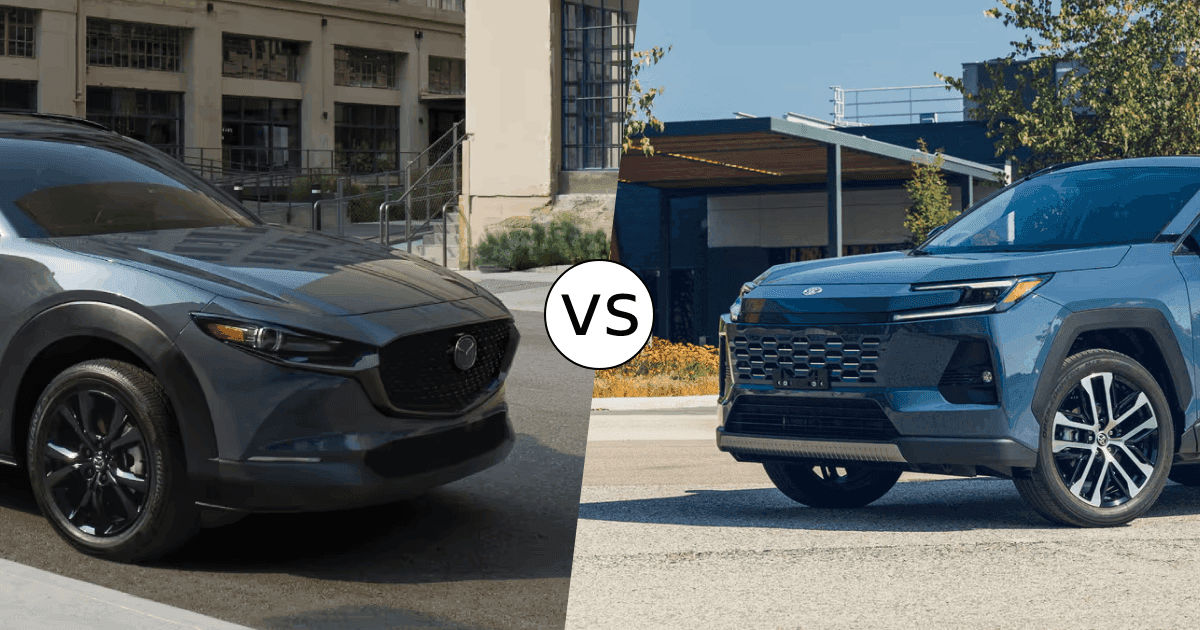
If you’re shopping for a compact SUV, the 2026 Mazda CX-30 and Toyota RAV4 are both good choices, but they have key differences. The CX-30 offers affordable pricing, a smooth driving feel, and an elegant interior, while the RAV4’s popularity is boosted by cargo capacity and hybrid fuel savings. Our team at Capistrano Mazda can help you figure out which one fits your Orange County lifestyle better.
What’s New for 2026
For 2026, Toyota completely redesigned the RAV4, including eliminating gas engines in favor of hybrid and plug-in hybrid powertrains. You’ll find three distinct design styles (Core, Rugged, and Sport) and the debut of the GR SPORT model. The power boost is significant, with RAV4 plug-in hybrids offering 324 hp combined and all-wheel drive (AWD) as standard. Hybrid models are expected to arrive at U.S. dealerships in December 2025, and plug-in hybrid models should be available in spring 2026.
For the CX-30, Mazda focused on upgrades to enhance daily driving. Every CX-30 now has a brake limited-slip differential as standard to improve traction and stability for rainy Orange County days or weekend mountain trips. Updated dampers mean a smoother ride during your daily commute. Tech upgrades include an available 10.25-inch display with touch-screen functionality for Apple CarPlay and Android Auto. There’s also a new Aire Edition trim with black badges, wheels, and mirrors, plus white leatherette and gray suede-like interior accents.
Pricing and Value Proposition
The 2026 Mazda CX-30 starts at $25,975 for the 2.5 S base model, with the top-tier 2.5 Turbo Premium Plus at $37,900. Premium paint options, such as Soul Red Crystal Metallic and Ceramic Metallic, cost an extra $595. The 2026 Toyota RAV4 starts at $33,350 and jumps to $41,350 for the Woodland trim. If you’re a budget-conscious Orange County driver, you’ll appreciate the CX-30’s luxury features at everyday prices.
Performance and Powertrain Comparison
The RAV4 Hybrid is powered by a 2.5-liter four-cylinder engine and two electric motors that combine for 226 hp with front-wheel drive (FWD) or 236 hp with AWD. Acceleration from 0 to 60 mph takes 7.1 seconds for the AWD model, which is 0.2 seconds quicker than the previous version. Toyota estimates fuel economy at 44 mpg in its most efficient configuration (LE Hybrid with FWD), with other hybrid models rated between 39 mpg and 42 mpg combined.
Mazda offers two completely different powertrains for the CX-30. The SKYACTIV-G 2.5-liter, four-cylinder naturally aspirated engine producing 186 hp and 186 lb-ft of torque is smooth and predictable, perfect for daily driving. For more excitement, the turbocharged CX-30 variants generate up to 250 hp and 320 lb-ft of torque using premium fuel or 227 hp and 310 lb-ft of torque using regular fuel. If you’re a driving enthusiast, the turbo model goes from 0 to 60 mph in approximately 6.2 seconds, nearly a full second quicker than the RAV4.
Towing and AWD systems tell different stories. RAV4s with FWD can tow 1,750 pounds, while most other models (the AWD LE is limited to 1,500 pounds), including all hybrids, offer up to 3,500 pounds of towing capacity. The CX-30, while not designed or recommended for towing, comes standard with i-ACTIV AWD, perfect for Orange County’s mix of coastal highways and mountain roads.
Interior Space and Practicality
The RAV4’s cargo capacity reaches 37.8 cubic feet behind the second row and nearly 70 cubic feet with rear seats folded, with slight variations for hybrid powertrains. Car and Driver testing demonstrated this advantage by fitting 10 carry-on suitcases in the cargo area behind the rear seats and 24 bags with the rear seats folded. Rear-seat room is adequate for two adults, with a third person fitting for short trips. Looking at technology, the RAV4’s interior features a 12.3-inch digital instrument cluster and a 12.9-inch touch-screen infotainment display on higher trims.
The CX-30’s total passenger volume is 94.1 cubic feet with seating for five passengers. Front-row dimensions include 41.7 inches of legroom, 38.1 inches of headroom, and 55.6 inches of shoulder room. Rear-row dimensions provide 36.3 inches of legroom, 38.3 inches of headroom, and 53.6 inches of shoulder room, enough for average-sized adults. The CX-30’s cargo space measures just 20.2 cubic feet with the rear seats upright and 45.2 cubic feet with the rear seats folded.
What the CX-30 lacks in size, it makes up for in style and quality. Storage solutions include a spacious glove compartment, a front center console, door storage pockets with bottle holders, and a rear center armrest with cup holders. Technology features include Mazda Connect with an 8.8-inch display (10.25 inches on select models), Apple CarPlay and Android Auto, and dual USB-C inputs. The CX-30’s interior features better materials, superior fit and finish, and a more refined atmosphere.
Your choice between Mazda vs. Toyota comes down to what matters most in your daily life. If you need maximum cargo space and outstanding fuel economy, the RAV4 makes perfect sense. The CX-30 is for you if you love driving and want a refined interior at an affordable price. Turbocharged CX-30s deliver genuine performance excitement that the RAV4 can’t touch.
Find Your Perfect Compact SUV at Capistrano Mazda
Test-drive the CX-30 to experience its refined driving character and premium interior for yourself. There’s no substitute for the Mazda’s real-world comfort, performance, and practicality. Visit our dealership in San Juan Capistrano to check out the complete 2026 CX-30 lineup and chat with our knowledgeable team. We’ll help you find the perfect compact SUV that matches your lifestyle and budget.
0 comment(s) so far on 2026 Mazda CX-30 vs. Toyota RAV4