



2026 Mazda CX-50 Hybrid vs. CX-70 PHEV: Which Electrified SUV Fits Orange County Drivers?
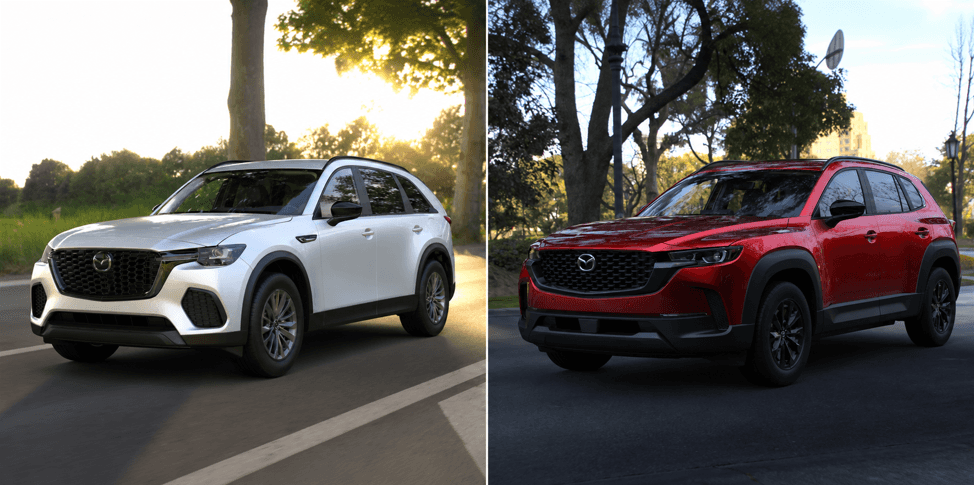
A full hybrid never plugs in, while a plug-in hybrid can run on electricity alone for a limited range and then switches to gas. That one difference drives most of the 2026 Mazda CX-50 Hybrid vs CX-70 PHEV decision. We hear from local drivers every week about charging and commuting, and the answer almost always begins with their home setup, long before the spec sheet comes into it. If you want to see either one in person, browse our new vehicles at Capistrano Mazda.
2026 Mazda CX-50 Hybrid vs. CX-70 PHEV: The Short Answer for Orange County Drivers
The CX-50 Hybrid suits you if you want electrified efficiency with no charging routine. The CX-70 PHEV makes more sense when you can plug in regularly, want more power, and need a larger cabin. Both seat five in two rows, so the CX-70 gives you extra width and cargo space but no third row. It is not the three-row CX-90.
| Spec | 2026 CX-50 Hybrid | 2026 CX-70 PHEV |
|---|---|---|
| Powertrain | 2.5-liter four-cylinder, three electric motors, hybrid battery | 2.5-liter gas engine, 68 kW electric motor |
| Output | Up to 219 hp, 163 lb-ft on regular 87-octane | Up to 323 hp, 369 lb-ft with recommended premium fuel |
| Drivetrain and transmission | e-AWD, e-CVT | Rear-biased i-ACTIV AWD, eight-speed automatic |
| Fuel economy and electric range | EPA-estimated 39 city / 37 highway / 38 combined mpg, no plug-in range | 30-mile EV range, 520 miles total range |
| Seating and cargo | Five, 29.2 cu. ft. upright, up to 56.3 cu. ft. folded | Five, 39.6 cu. ft. behind second row, 75.3 cu. ft. folded |
Quick Match by Driver Type
Without reliable charging, the CX-50 Hybrid is the better fit, since it never needs an outlet. It’s also the smaller of the two, a plus if easy parking and maneuvering matter to you.
Can you charge at home or work? Then the CX-70 PHEV lets shorter trips run on electricity. Look at it too if you need cargo room, a wider cabin, or towing.
Neither is universally better. The right one depends on how you will use the electrified powertrain.
Full Hybrid vs. Plug-In Hybrid: What Is the Practical Difference?
Both pair a gas engine with electric motors. What separates them is the role electricity plays and how the battery gets its charge. That distinction shapes your ownership routine more than any horsepower number.
How the CX-50 Hybrid Works Without Plugging In
The 2026 Mazda CX-50 Hybrid is primarily gas-powered. Its three electric motors can propel it briefly at low speeds, reduce idling, and power auxiliary systems. The hybrid battery charges through regenerative braking and the gas engine, with no external charging. That makes it a simple fit if you lack a dependable place to plug in. The battery exists to boost efficiency, and you can’t select it for an electric commute.
How the CX-70 PHEV Uses Electric-Only Driving and Charging
The 2026 Mazda CX-70 PHEV uses EV mode for typical city driving. The gas engine can engage for extra acceleration or when the battery runs low, so electric-only driving isn’t guaranteed in every situation. The battery recharges through regenerative braking, the engine, or an external Level 1 or Level 2 charger. It can’t operate without gasoline in the tank. On longer drives with the engine on, it behaves like a traditional hybrid. EV mode produces no tailpipe emissions.
Fuel Economy, MPGe, and Electric-Only Range
The CX-50 Hybrid carries an EPA-estimated 39 city, 37 highway and 38 combined mpg, with a total range of 551 miles, which makes it the straightforward pick for Mazda hybrid vs. plug-in hybrid fuel savings without any plug. The CX-70 PHEV offers a 30-mile EV range when fully charged and 520 miles of total range. We won’t line up its efficiency number against the CX-50’s mpg, because the two measure different operating conditions.
In practice, a CX-70 PHEV driver who charges consistently can cover much of their driving on electricity and use far less gas. One who rarely plugs in will mostly drive it as a hybrid. EPA mpg and electric range are estimates, and real results vary with how you drive, the terrain, the temperature, and how often you charge.
Charging Requirements: Is a Plug-In Mazda Right for Your Home and Commute?
The CX-50 Hybrid needs no charging equipment at all. The CX-70 PHEV includes a portable Level 1 cable for a standard 120-volt outlet, which takes approximately 11 hours. An available Level 2 home charger takes approximately 2.5 hours. The MyMazda app helps you locate public charging. Charging needs the right outlet and electrical setup, so have it checked before you count on it.
A few questions help sort out whether charging fits your life:
- Is there a garage or driveway outlet you can use every night?
- Would your HOA or landlord allow charging equipment?
- Does your workplace offer charging?
If you answered yes to the first question or the third, the PHEV is realistic. If all three are uncertain, the CX-50 Hybrid is the safer match. Picture a short commute on the 405 or I-5 in stop-and-go traffic. A plugged-in CX-70 PHEV could cover much of that week in EV mode, while the CX-50 Hybrid simply keeps sipping fuel with no planning. Questions about your setup? Contact us and our team will talk it through.
Performance, AWD, and Towing Compared
The CX-70 PHEV delivers up to 323 hp and 369 lb-ft, so it feels stronger when merging or climbing, while the CX-50 Hybrid, at up to 219 hp, leans toward efficiency. Both offer AWD, but they drive differently. The CX-50 Hybrid pairs e-AWD, which controls the front and rear wheels independently, with an e-CVT and Mi-Drive Power and Trail modes. The CX-70 PHEV uses standard rear-biased i-ACTIV AWD in both electric and hybrid operation, an eight-speed automatic, and Mi-Drive Sport, Off-Road and EV modes.
Both can tow, but at different levels. The CX-50 Hybrid is rated for up to 1,500 lb, enough for a small utility trailer or a pair of personal watercraft. The CX-70 PHEV tows up to 3,500 lb when properly equipped with a tow hitch, offered as a dealer-installed or port-installed accessory. If you tow anything heavier than a light trailer, the CX-70 is the model to consider. Test drive both and pay attention to how they accelerate and brake.
Size, Seating, and Cargo: Which Fits Your Daily Life?
Both are five-passenger, two-row SUVs. The CX-70 is a larger, midsize two-row SUV, with more cabin width and cargo room. The CX-50 Hybrid’s smaller footprint is easier in tight San Juan Capistrano parking lots and older garages.
The size gap is bigger than the badges suggest. The CX-50 Hybrid measures 186.1 inches long on a 110.8-inch wheelbase, while the CX-70 PHEV stretches to 200.8 inches on a 122.8-inch wheelbase, and it’s 77.6 inches wide with the mirrors folded versus the CX-50’s 72.9.
Inside, the CX-70 offers 39.4 inches of rear legroom to the CX-50 Hybrid’s 37.8. Cargo shows the clearest split, with 29.2 cu ft behind the rear seats and up to 56.3 cu ft folded in the CX-50 Hybrid, versus 39.6 and 75.3 cu ft in the CX-70 PHEV. Measure your garage before you decide, especially if it’s an older one.
Commuting, Longer Trips, and Lifestyle Fit
Think about your routine first. The CX-50 Hybrid gives you fuel-saving assistance on every drive with no charging stops to plan. The CX-70 PHEV suits shorter, regularly recharged trips, and its gas engine keeps longer drives to Los Angeles or San Diego easy. Once the electric charge is used, it runs as a hybrid, so gas efficiency matters more on long trips.
Choose the CX-50 Hybrid If You…
- Want electrified fuel efficiency without adding charging to your schedule.
- Have limited or uncertain access to a suitable charger.
- Prefer a smaller SUV for routine parking and maneuvering.
- Need five seats, practical cargo space and light towing up to 1,500 lb without the larger model’s size.
Choose the CX-70 PHEV If You…
- Have reliable charging access and intend to use it regularly.
- Want shorter trips on electricity with a gas engine ready for longer journeys.
- Need more cabin width and cargo room, but can skip the third row.
- Value stronger acceleration and a 3,500 lb towing ceiling when properly equipped.
FAQs: CX-50 Hybrid vs. CX-70 PHEV
Does Mazda make a plug-in hybrid? Yes. The CX-70 PHEV is the plug-in hybrid SUV covered here. The CX-50 Hybrid is a full hybrid.
Do I have to plug in either one? Not the CX-50 Hybrid. The CX-70 PHEV can recharge through braking and the engine, but external charging restores its electric-only range.
Can the CX-70 PHEV keep driving once the electric range is used? Yes. The gas engine and hybrid system continue as long as there is gasoline.
Which is more efficient? The CX-50 Hybrid has the 38 combined mpg estimate. The CX-70 PHEV can use less gas if you charge often. Real results vary.
Do both seat five? Yes, in two rows. The CX-70 is simply roomier.
Which one tows? Both. The CX-50 Hybrid is rated for up to 1,500 lb, and the CX-70 PHEV for up to 3,500 lb when properly equipped.
Do electrified SUVs still need service? Yes. Our service department handles scheduled maintenance for both.
Explore Both Electrified Mazda SUVs at Capistrano Mazda
Capistrano Mazda is a Southern California Mazda dealership offering new and used vehicles, financing, service, and parts. Explore our current hybrid inventory and the model pages for the 2026 Mazda CX-50 Hybrid and 2026 Mazda CX-70 PHEV. Availability and trims vary, with the CX-50 Hybrid offered in Preferred, Premium, and Premium Plus and the CX-70 PHEV in SC and SC Plus, so contact us for current inventory and test drives. Bring your commute and parking details, tell us how you’d charge, and we’ll help you compare.
- Address: 32852 Valle Rd, San Juan Capistrano, CA 92675
- Sales: (833) 753-0710
- Hours: Mon–Fri 8 AM–7 PM, Sat 9 AM–7 PM, Sun 10 AM–6 PM
0 comment(s) so far on 2026 Mazda CX-50 Hybrid vs. CX-70 PHEV: Which Electrified SUV Fits Orange County Drivers?