



How To Change a Mazda’s Tire
Knowing how to change a flat tire will save you from waiting for roadside assistance and the costs related to enlisting help. In this guide, our experts at Capistrano Mazda walk you through the Mazda tire replacement process and provide helpful tips to keep you safe on the road.
Essential Safety Preparations Before Your Mazda Tire Change
Safety is essential before changing your Mazda’s flat tire. Since busy shoulders are hazardous, pull completely off the road onto solid, flat ground, avoiding soft dirt or hills. Turn on your hazard lights immediately to ensure that you’re visible to other drivers and firmly secure the parking brake. Put your vehicle in park if you have an automatic transmission and in first gear if you have a manual version.
Place chocks behind the wheels opposite your flat tire and put warning triangles about 100 feet behind your car. Make sure all passengers are out of the car and away from traffic. If you’re on a busy highway, in bad weather conditions, or on unstable ground, you should get professional roadside assistance.
Tools and Equipment You’ll Need
Your Mazda comes with everything you need for a tire change, including a spare tire, a jack, a lug wrench, and an owner’s manual (except for the MX-5 Miata and MX-5 Miata RF, which have an emergency flat tire repair kit instead). The spare tire is located in different places depending on your model, with sedans, such as the Mazda3 and Mazda6, typically storing it under the cargo floor. The Mazda CX-9 and CX-5 spare tire location may be underneath the vehicle or in the back.
Knowing where to put the jack is essential since placing it in the wrong location can damage your car and cause accidents. Your manual clearly indicates the location of the reinforced jack points. You should also check your spare tire’s air pressure monthly.
Step-By-Step Tire Removal Process
Starting with the flat tire touching the ground for stability, loosen the lug nuts using your lug wrench, but don’t remove them completely. If the nuts are tight, don’t jerk or pull the wrench; place your foot on it and press down.
Find your Mazda’s specific jack points, place the jack carefully, and raise the vehicle slowly until the flat tire clears the ground. Remove the loosened lug nuts completely and store them safely. Pull the tire straight toward you using your leg muscles, not your back. Always consider safety first. Never crawl underneath a car held only by a jack. Take your time since rushing can cause vehicle damage or personal injury.
Installing Your Mazda’s Spare Tire
Align the spare tire so that its holes align with the wheel studs. Carefully lift the spare onto the hub and screw on the lug nuts by hand — just finger-tight to keep the wheel in place without using a wrench yet. Begin tightening the lug nuts in a star pattern, alternating across from one nut to the opposite one, ensuring even pressure distribution to prevent warping. Lower your car until the spare tire touches the ground and bears some of the vehicle’s weight. This will prevent the wheel from turning while you tighten the nuts.
With the tire touching the ground, use the wrench and your full body weight to firmly tighten the lug nuts as much as possible since a loose wheel is extremely dangerous. Fully lower the car, remove the jack, and recheck each nut to ensure that they’re secure.
Understanding Different Mazda Spare Tire Types
Your Mazda’s spare is designed for temporary use only, since it’s smaller and lighter than regular tires. You shouldn’t drive faster than 50 mph or travel more than 50 miles. In an emergency, you can increase this distance to 70 miles, but it’s not recommended.
Using a temporary spare on the front wheels can negatively affect your vehicle’s handling, increasing the risk of losing control, especially on slippery surfaces. For all-wheel-drive (AWD) Mazdas, such as the CX-5, using the spare tire for extended periods can damage the differential, as mismatched tire sizes force the AWD system to work harder, causing expensive drivetrain issues.
Many new cars no longer come with spare tires due to manufacturers’ efforts to reduce costs and weight, often providing tire repair kits instead that include sealant and an air compressor. Since most drivers prefer having a spare tire for peace of mind, Mazda includes them in most models.
Postinstallation Safety Checks and Next Steps
Check your spare tire’s pressure immediately. You can find the correct psi level on the sticker inside your driver’s door jamb or fuel filler cap. Check this when the tires are cold, preferably in the morning or after parking for at least three hours.
Ensure that you clean the jack, wrench, and tools, and return them to their designated spots. If your Mazda is equipped with a tire monitoring system, it may require resetting, although it’ll usually recalibrate after driving a few miles. Maintaining proper tire pressure also improves fuel efficiency.
When To Seek Professional Help
Some tire problems are beyond the scope of DIY repairs. If you notice sidewall damage, multiple punctures, or structural issues, it’s recommended to contact a professional. Most blowouts are caused by underinflation, and tires older than 6 years may be susceptible to failure due to age and road wear, regardless of their appearance.
Consider your surroundings before changing your car’s tire. Heavy traffic, adverse weather conditions, unstable ground, and poor lighting can all increase the risk. If you feel unsafe or unsure about changing the tire, it’s best to enlist the help of a professional.
Watch for signs such as difficulty accelerating, stiff steering, fluid leaks, brake problems, vibrations while driving, unusual engine sounds, an illuminated check engine light, or exhaust issues that may indicate that your car needs professional attention.
Preventing Future Tire Emergencies
Routine maintenance prevents most tire problems. Manufacturers suggest rotating your tires every 5,000 to 7,500 miles, depending on your tire type, drivetrain, and driving habits. AWD vehicles need rotation every 3,000 to 5,000 miles since power is distributed to all four tires. Regular rotation improves traction, reduces road noise, relieves drivetrain stress, and extends tire life.
Practice changing a tire at home or in an empty parking lot to build your confidence. Keep your manual handy for information on jack points and air pressure levels. Prepare an emergency kit that includes a flashlight with batteries, gloves, first aid supplies, water, snacks, a blanket, and basic tools. Check your car’s tires regularly for wear patterns, cracks, bulges, or debris to identify any problems early.
Get Expert Service and Tire Care at Capistrano Mazda
Although knowing how to change a tire yourself gives you freedom, regular professional maintenance is the best way to prevent emergencies.
If you’re in San Juan Capistrano, contact us for professional advice and service. Our factory-trained technicians are familiar with all Mazda models, from the correct lug nut torque to AWD rotation intervals. We offer thorough tire checks, professional installations, and preventive care that extends tire life while keeping you safe on Orange County’s diverse roads.
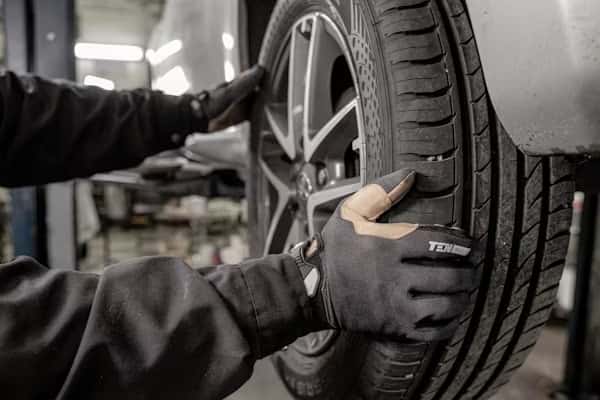
a man working on a tire in a garage by Jimmy Nilsson Masth is licensed with Unsplash License
0 comment(s) so far on How To Change a Mazda’s Tire